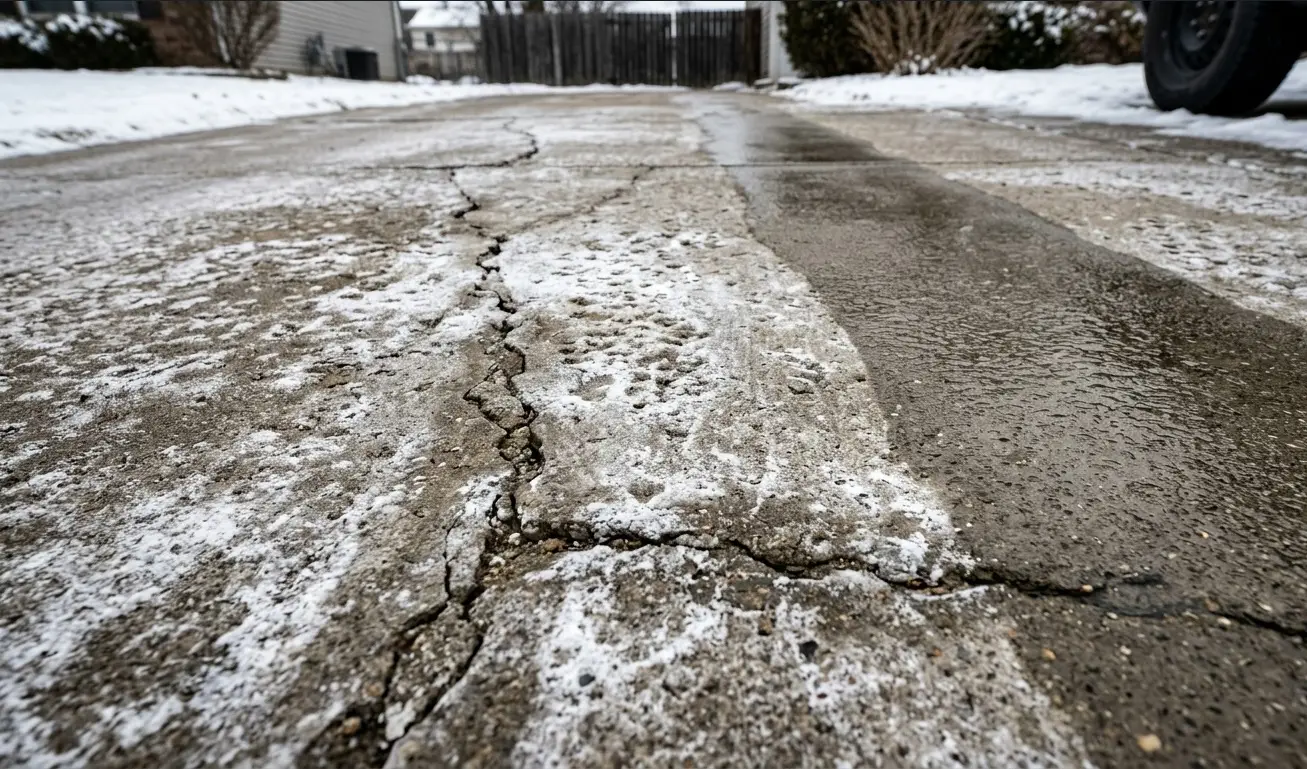
While Long Island property managers focus on the immediate safety of clear walkways, a silent chemical reaction is currently eating away at your most expensive physical assets. Winter salt isn’t just melting ice; it is actively compromising the structural integrity of your concrete, leading to repair costs that far exceed the price of seasonal maintenance.
The High Cost of Concrete Erosion on Long Island
It is a common misconception that concrete is an impenetrable solid. In reality, concrete is a porous, stone-like sponge. When road salt (sodium chloride) is applied to melt ice, it dissolves into a brine that seeps deep into these pores.
Concrete Repair Costs
The Cost of Replacement: According to local construction data, the cost of a full concrete sidewalk or driveway replacement on Long Island currently ranges from $15 to $30 per square foot, with labor rates for specialized repairs in the Nassau/Suffolk area reaching $70 to $160 per hour.
The ROI of Maintenance: Investing in professional pressure washing and neutralization is roughly 2% to 5% of the cost of a full replacement. In contrast, sidewalk repairs can yield a 60% to 85% return on investment (ROI) by preventing premature structural failure and boosting property appraisal values.
Liability Risks
Premises Liability: In New York, property owners are legally obligated to keep sidewalks and parking lots free of hazards. In Nassau and Suffolk Counties, slip-and-fall incidents caused by “uneven pavement” (often caused by salt-induced spalling) are a leading cause of premises liability lawsuits.
Salt Volume: Private businesses and HOAs are responsible for approximately 50% of the chloride load found in local runoff. On Long Island, this salt doesn’t just damage the surface; it infiltrates our local aquifers, making “salt management” a community-wide environmental responsibility.
Quantifying the Risk: Liability and Asset Depreciation for Property Managers
The “cost of doing nothing” is rarely zero. Depending on your role, the buildup of winter salt represents a specific financial or operational risk:
- For HOA Board Members: Salt damage directly impacts “curb appeal,” which is a primary driver of property value. Crumbling walkways lead to resident complaints and can eventually necessitate a special assessment to cover massive replacement costs; a situation every board wants to avoid.
- For Commercial Property Managers: Your priority is tenant retention and liability. Pitted, uneven concrete is a primary cause of trip-and-fall incidents. In 2026, the average cost of a standard concrete driveway repair ranges from $830 to $2,800, while a full replacement can easily exceed $10,000.
- For Healthcare Facility Administrators: Compliance and safety are non-negotiable. Salt tracked into the building also destroys interior flooring, doubling your maintenance labor costs.
“The Long Island Factor: Unlike inland regions, our coastal properties face a ‘Double-Salt’ threat: the road salt applied in winter and the constant salt spray from the Atlantic and the Sound. This accelerates the oxidation of rebar within your concrete, leading to ‘blowouts’ and cracking much faster than properties just 50 miles north.”
Cost vs. Risk: What Property Owners Need to Understand
| Scenario | Cost |
| Pressure washing (annual) | $300 – $2,500 |
| Concrete resurfacing | $3,000 – $8,000 |
| Full replacement | $5,000 – $15,000+ |
| Slip-and-fall claim | $20,000 – $50,000+ |
Preventative cleaning is a small investment compared to the long-term financial risk of neglect.
The Solution: Professional Long Island Pressure Washing & Neutralization.
Removing salt isn’t about a quick rinse; it’s about a chemical neutralization and deep-pore extraction. Traditional pressure washing without the correct flow and temperature can actually push salt deeper into the concrete.
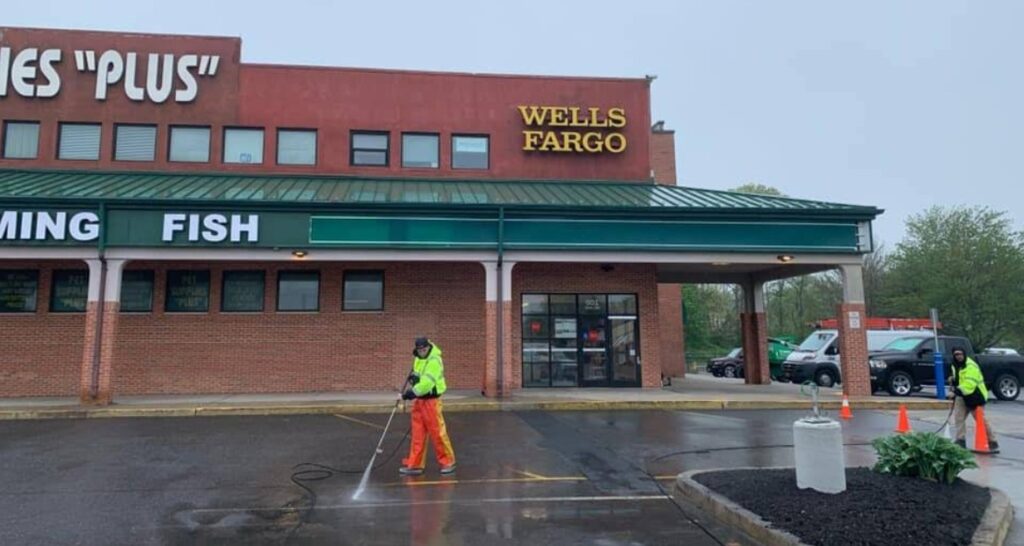
Above All Pressure Cleaning utilizes a professional-grade exterior maintenance strategy that goes beyond surface cleaning. Our process involves:
- High-Volume Rinse: To clear the heavy surface deposits.
- Neutralizing Agents: To break the ionic bond between the salt and the concrete.
- Preventative Assessment: Identifying early signs of spalling before they become structural failures.
Protect Your Assets Before the Spring Thaw
Don’t wait for the white salt streaks to turn into permanent cracks. Transition your property from a “reactive” cleaning mindset to a “proactive” asset protection strategy.
Whether you manage a residential estate or a sprawling commercial complex, the time to neutralize winter damage is now.
Schedule preventative maintenance here: Above All Pressure Cleaning
Secure your property’s value today.
Pressure washing is not just cleaning—it’s property protection, risk management, and cost control.
Contact Above All Pressure Cleaning for a professional site assessment or explore our Commercial Pressure Washing Services to see how we protect Long Island’s most prominent properties.
Salt penetrates concrete pores and accelerates freeze-thaw cycles, causing internal cracking, surface scaling, and long-term structural deterioration.
Early spring is the best time to remove salt buildup before it causes deeper damage. This prevents long-term deterioration and extends surface lifespan.
Yes, professional pressure washing effectively removes salt residue from concrete surfaces, preventing chemical damage and surface breakdown.
Surface damage can sometimes be treated, but deep structural damage may require resurfacing or replacement. Preventative cleaning is the most cost-effective solution.