Soft washing that lifts algae, mildew and salt off your siding without stripping paint or forcing water behind it. Safe for your landscaping, your pets and your home.
What darkens siding on Long Island usually isn’t dust. It’s living.
Algae and mildew take hold wherever surfaces stay damp — north-facing walls, anything shaded by trees, the lower few feet where sprinklers hit. They don’t sit on top of the siding. They root into the texture of it, which is why rinsing with a garden hose makes almost no difference.
Near the water, salt compounds it. Coastal air deposits a fine saline film that holds moisture against the surface, and moisture is exactly what organic growth needs. South Shore and East End homes tend to show it first and worst.
Then there’s oxidation. Vinyl and aluminum siding chalk as they age — that powdery residue on your hand when you touch the wall. It dulls color, and it traps everything else.
Left alone, all three feed each other. The growth holds moisture, the moisture accelerates oxidation, and the surface keeps getting darker until people stop seeing the house and start seeing the state of it.
Siding is one of the easiest surfaces to ruin with a pressure washer, and we get called to look at the results regularly.
High pressure on vinyl forces water up behind the panels, where it sits in the wall cavity. It etches the surface, leaving a permanently dulled patch that catches dirt faster than the siding around it. On painted wood or fiber cement it strips finish outright. On stucco it opens the surface.
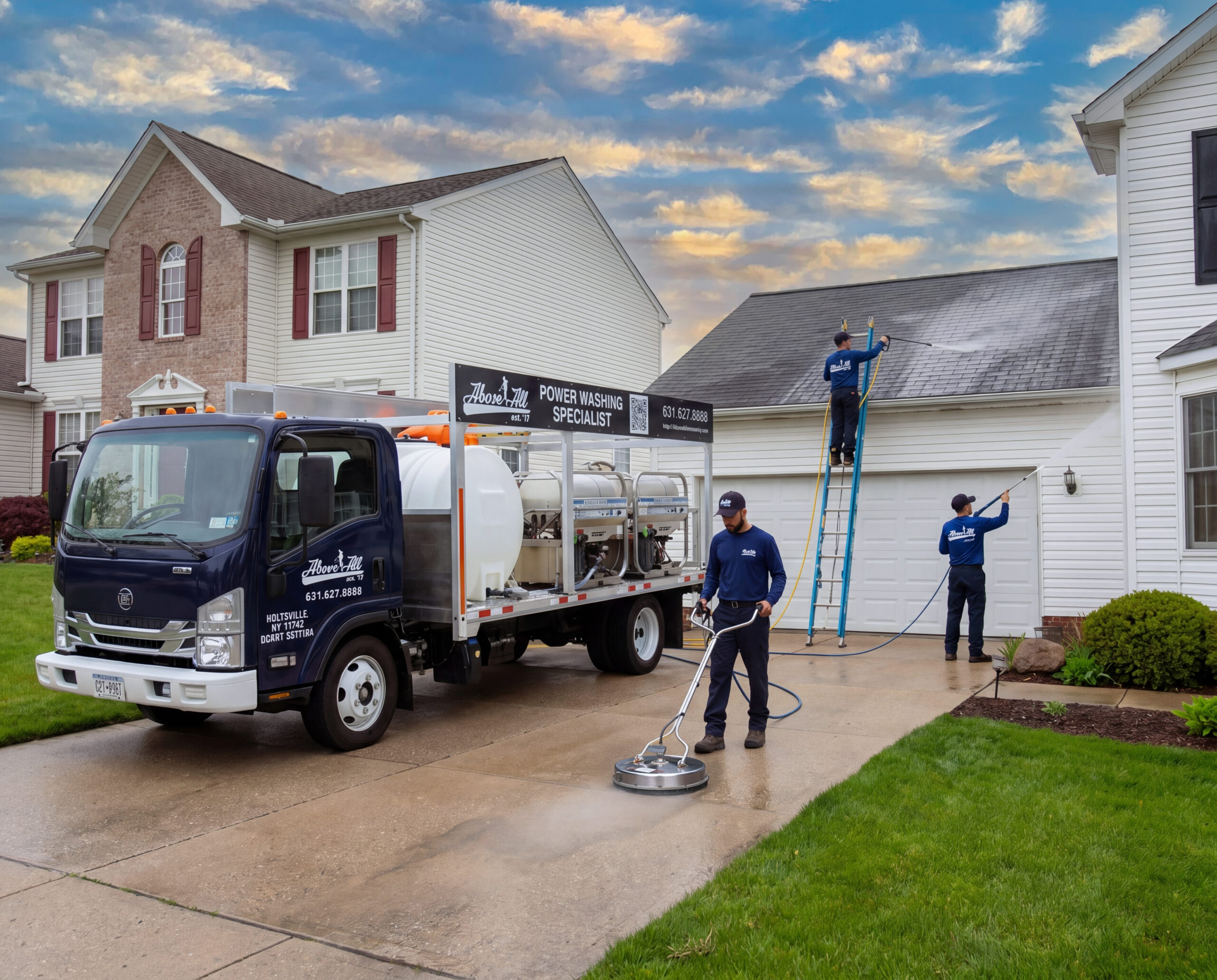
Soft washing solves it differently. We apply professional-grade cleaning solutions at low pressure — around the force of a heavy rain shower. The solution breaks the algae and mildew down at the root, kills the spores rather than just removing what’s visible, and then we rinse.
The chemistry does the work. The pressure only carries it away. That’s also why the result lasts longer.
Before we start, we protect the property. Landscaping gets watered down and covered. Fixtures, cameras, doorbells and outlets get shielded. Everything gets rinsed again when we finish.
A house wash cleans the outside of your gutters, but the heavy black vertical streaking known as tiger striping is oxidation bonded to the metal and needs a separate treatment. We handle it as gutter brightening and usually do it in the same visit.
For most Long Island homes, once a year to every other year is the right rhythm. What moves it either way is exposure.
The economics are simple. Annual washing is maintenance. Waiting five years is restoration, and by then the growth has usually caused staining that no wash fully reverses.
If you’d rather not think about it, our residential membership schedules it automatically at member rates, from $39 a month.
Most exterior damage we’re asked to fix was caused by cleaning. Knowing which surfaces take pressure and which need chemistry is the entire job.
Landscaping pre-wet and covered, fixtures shielded, everything rinsed after. It takes longer, and it’s why we don’t leave damage behind.
Members of the Power Washers of North America — standards around method, insurance and environmental practice. Very few Long Island companies hold it.
Founded in 2014 and still run by the person who started it. 4.9 stars across 243 Google reviews.
Most homeowners combine these — one mobilization, one visit, better pricing than booking separately.
Not the way we do it. We soft wash — low pressure, roughly the force of heavy rain, with cleaning solutions doing the actual work. The damage people associate with house washing comes from high-pressure machines on surfaces that can’t take them, which is exactly what we avoid.
Yes. We use biodegradable, professional-grade solutions, and we pre-wet and cover landscaping before starting, then rinse everything afterward. Pets should stay inside while we work, and can come back out once the final rinse is done.
Most homes take two to four hours depending on size, siding type and how much growth has built up. Larger properties or heavily affected surfaces take longer. We’ll give you a realistic window when we quote.
You can, and we’re regularly called out to repair the results. Rental machines deliver inconsistent pressure with no control over solution strength, which is how siding gets etched and water gets forced behind panels. The bigger issue is that pressure alone doesn’t kill algae spores — it removes what’s visible and the growth returns within months.
Typically a year or two, depending on exposure. Shaded, north-facing and coastal properties regrow faster. Because soft washing kills the spores rather than just rinsing off surface growth, it lasts considerably longer than a pressure wash.
Yes — vinyl, aluminum, wood, fiber cement, stucco, brick and natural stone. Each needs a different approach, and matching the method to the material is the part that matters.
Around here people use ‘power washing’ to mean exterior cleaning generally. House washing is the specific job of cleaning your siding and exterior walls, and for most homes that means soft washing rather than high pressure.
Spring and fall are ideal — spring clears winter salt and buildup, fall removes what accumulated over a humid summer. We work year-round, and mild winter days are perfectly workable.
Tell us about your home and we’ll come back within 24 hours.
We’ll be in touch within 24 hours. Urgent? Call 631-627-8888 — we answer around the clock.