
Pre-war co-ops, cast-iron lofts, storefront blocks and the garages underneath. In Manhattan, the cleaning is the easy part — not bothering the building is the job.
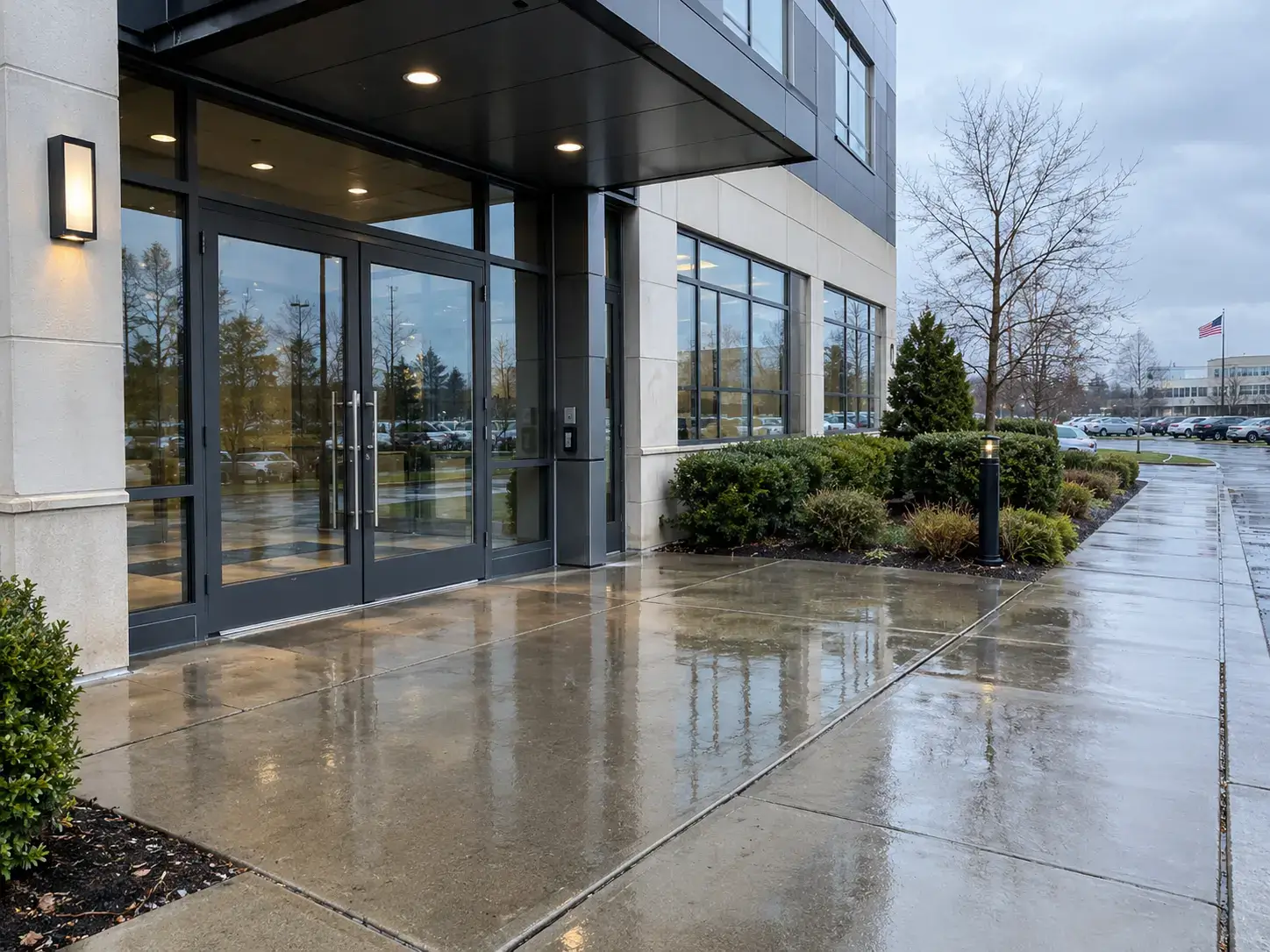
There’s a doorman, a super, a managing agent and a board — and usually a neighbor on each side who’d like to know what you’re doing.
Limestone, terra cotta, carved brick and cast iron. Beautiful when they’re clean, and easy to scar with the wrong pressure. Much of the island is landmarked, and the city sets the limits.
The owner or occupant answers for the sidewalk and 18 inches of gutter. On a busy block that’s coffee, grease, gum and whatever came off the trash bags overnight.
Nearly every elevator building has one, plenty of them older than anyone in the building. Hopper rooms on each floor, a compactor room in the basement, and every smell in the building starts there.
Facade inspections put sidewalk sheds over a lot of entrances. Underneath, the sidewalk stays dark and damp, and the pigeons move in.
Harlem, Chinatown, the East Village and the Lower East Side are city rat mitigation zones, and West Harlem is already on the city’s on-street trash containers. In those blocks, the bin areas and compactor room aren’t cosmetic.
Limestone and brick co-ops on Park, Fifth, Central Park West, West End and Riverside, with doormen, canopies and courtyards — and side streets of brownstone townhouses.
What it needs: Entrances and canopies, courtyards, sidewalks, chutes and compactor rooms, gentle facade work.
Brownstone and limestone rowhouses, including landmarked rows like Strivers’ Row and around Mount Morris Park. Harlem is a rat mitigation zone; West Harlem already uses the city’s on-street containers.
What it needs: Soft stone cleaned at low pressure, stoops and areaways, bin areas kept clean.
Brick and Art Deco apartment buildings, courtyards and steep sidewalks. Big buildings, busy hopper rooms, old chutes.
What it needs: Chute and compactor-room cleaning, courtyards, entrances and sidewalks.
Painted cast-iron fronts, loft buildings and ground-floor retail, most of it landmarked. Cast iron is limited to 300 psi, and for good reason.
What it needs: Detergent and low pressure on iron, storefront glass and vault-light sidewalks handled with care.
Five-story walk-ups over storefronts, restaurants on every corner and trash at the curb most nights. Three of the city’s rat mitigation zones.
What it needs: Sidewalk degreasing to the gutter line, bin areas, rear yards, storefronts.
Office towers, plazas, garages and storefronts, plus the office buildings downtown that have been converted to apartments — with new chutes and compactor rooms to look after.
What it needs: Plazas and entrances, garage degreasing, storefronts, chutes in converted buildings.
18
in.
City rules make owners responsible for the sidewalk and 18 inches into the street. A broom handles litter; it doesn’t handle grease, gum or the stain under the bins.
500
psi
On landmarked buildings and in historic districts, the Landmarks Preservation Commission caps water pressure on masonry at 500 psi and bans sandblasting outright.
300
psi
Cast-iron facades get an even lower 300 psi limit. Most of the damage we see on old fronts came from someone ignoring both.
3+
units
Under Local Law 55, owners of buildings with three or more apartments must use integrated pest management — and sanitation of trash areas is part of it.
Entrances, canopies and lobby fronts · Courtyards and light wells · Trash chutes, hopper rooms and compactor rooms · Bin areas · Garages under the building
Sidewalk degreasing and gum removal · Storefront glass, gates and awnings · Plazas and building entrances · Graffiti removal matched to the surface · Loading and service entrances
Brownstone and limestone, soft washed · Cast iron at low pressure · Stoops, areaways and ironwork · Clean-up after a sidewalk shed comes down · Rust and calcium staining
Most of Manhattan’s buildings are older than anyone working in them, so we start gentle: detergent and dwell time, a test patch, and pressure only where the surface can take it — never above 500 psi on landmarked masonry or 300 on cast iron.
Runoff stays out of the catch basin, the entrance stays open, and the people in the building hear about it before it happens.

| Property | Typical Rhythm |
|---|---|
| Busy retail sidewalks | Monthly or more next to food; quarterly elsewhere |
| Building entrances and canopies | Quarterly to twice a year |
| Trash chutes and compactor rooms | Quarterly in large or busy buildings; at least annually everywhere |
| Garages | Twice a year for decks and ramps; spot-degreasing as needed |
| Facades | Every few years, gently — and right after a shed comes down |
Most buildings put this on a commercial program so it stops being a line item someone has to remember.
Power washing my HOA common property. Gerard and Jeffrey used their high quality machines to power wash our pool house, entire pool area, sidewalks around the community, cobblestone curbs and mailboxes. They did a fabulous job. Above All will remain at the top of our list to fill our needs of the HOA.
— Verified Google review
243 Google reviews
Soft washing and detergents before pressure, a test patch before a whole facade, and pressure kept inside the limits the city sets for old stone.
Accountable to the Power Washers of North America on method, insurance and wastewater — which matters when the catch basin is ten feet from the work.
Access, water, lock-outs and notices with the people who run the building; COIs and written scope for the office.
4.9 stars across 243 Google reviews, and a phone that gets answered at any hour.
National brands run procurement processes and hold their vendors to a standard. We’ve earned that work and kept it.






Brownstones, storefront avenues and houses by the bay.
Bayside to the Rockaways, LIC to Forest Hills.
The full shaft, every hopper door and the compactor room.
That’s most of the planning. We work in sections so the entrance stays open, keep hoses tidy and out of the way, and schedule around deliveries, move-ins and the busiest hours on the block.
Exterior work is scheduled for times that suit the building and the city’s noise rules. Chute and compactor-room work is indoors, so it’s usually done early in the morning before the building wakes up.
Yes, carefully. Cast iron is painted metal, and the Landmarks Preservation Commission limits pressure on it to 300 psi. We clean it with detergent and low pressure, without stripping paint or forcing water into the joints.
Some business improvement districts run their own sidewalk cleaning, which helps. It doesn’t change the city rule: the owner or occupant is responsible for the sidewalk and 18 inches of gutter in front of the property.
Yes. Certificates of insurance are issued before we arrive, made out the way your managing agent asks for them, along with a written scope the board can approve.
Yes. Plenty of older buildings run their compactor on a chute that started life as an incinerator flue. Older shafts often have rougher walls and more buildup, which is a reason to clean them more often, not less.
Yes. Years under a shed leaves the facade, the sidewalk and the entrance dark, damp and covered in droppings. Cleaning it up right after the shed comes down is the quickest way to make the building look like itself again.
Tell us the building and what needs attention. We’ll come back within 24 hours with next steps.
We’ll be in touch within 24 hours. Urgent? Call 631-627-8888 — we answer around the clock.