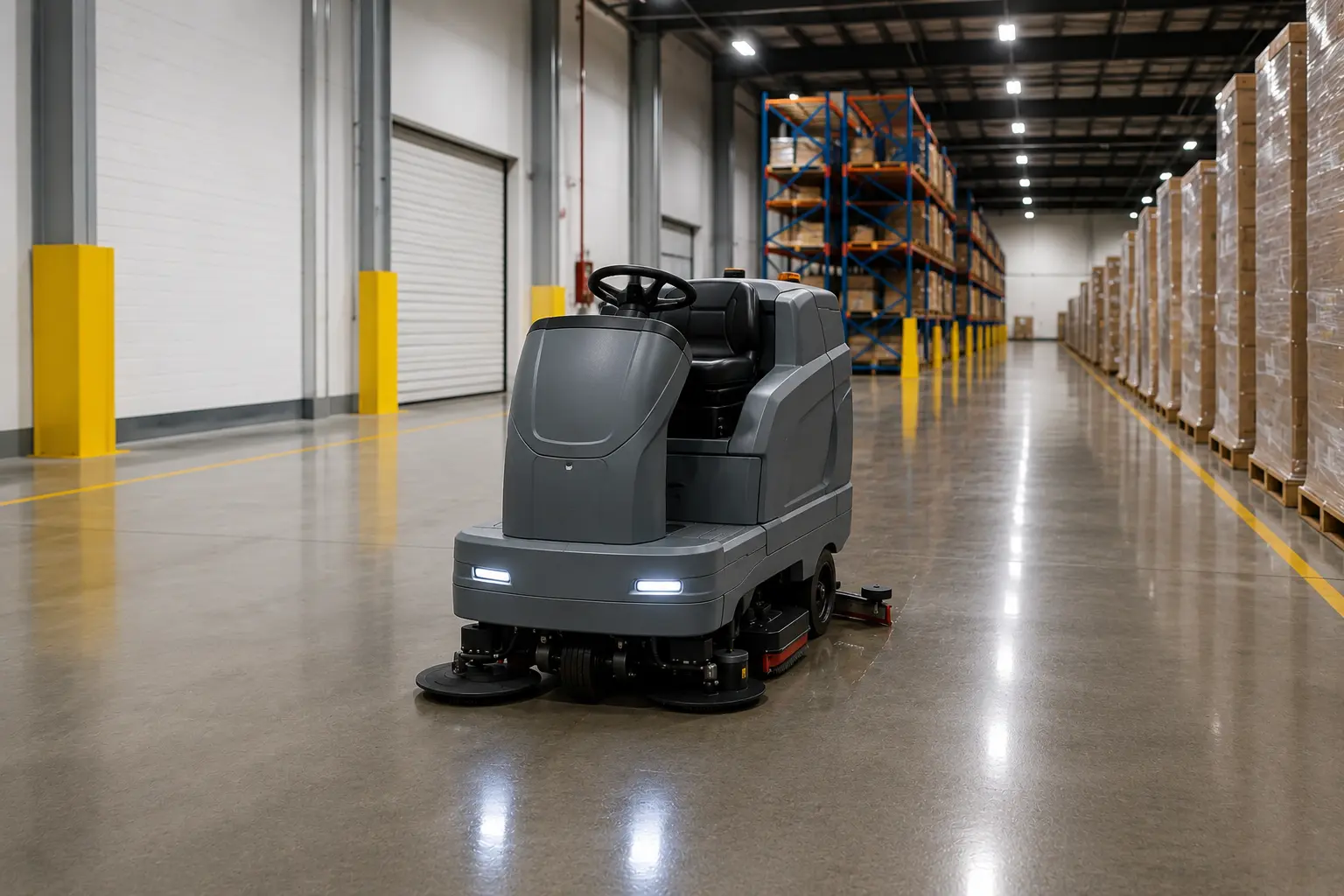

A hangar looks clean until you walk the floor with a flashlight. Fuel spots near the tow points. A gray film of tire rubber and hydraulic fluid spreading out from where the aircraft sits. Road salt tracked in over a Long Island winter, sitting in the low spots where meltwater pools. Aircraft hangar cleaning on Long Island rarely feels urgent, which is exactly why it gets pushed to next quarter until a slip, a failed inspection, or a corrosion question forces the issue.
The buildup does not announce itself. It accumulates on a schedule nobody set, and by the time it is obvious, it has already started costing you.
What builds up in a hangar, and why it matters
The floor of an active hangar collects a specific mix of contaminants. Jet fuel and avgas drips near fueling and tow points. Hydraulic fluid and engine oil under the aircraft. Tire rubber ground in from repeated repositioning. Dust and fine grit that drift in every time the doors open. In winter, the salt and brine that road crews put down on Long Island roads rides in on tires and boots and settles into the concrete.
Each of those has a consequence a facility manager cares about.
A film of oil and fuel on a hangar floor is a slip hazard for crews and a fire consideration in a space full of ignition sources. Fine dust does not just look bad, it settles onto airframes and works into surfaces and equipment between flights. Salt is the quiet one. It holds moisture against concrete and metal, and on a coastal island it is already in the air. Left in place, it accelerates corrosion on the one thing your whole operation exists to protect: the aircraft.
There is also foreign object debris. A clean floor is part of FOD control. Grit and loose material on the ground near a running engine or a moving prop is a known risk, and a floor that is swept but never deep-cleaned still holds plenty of it in the pores of the concrete.
Private hangars and public airfields have different problems
Long Island runs the full range. Republic Airport in Farmingdale is a public, state-owned field built around business and general aviation, with hundreds of based aircraft and a mix of FBOs, flight schools, and corporate operators. MacArthur in Islip handles commercial and private traffic with several FBOs. Gabreski in Westhampton, East Hampton, and Brookhaven round out the picture. Private jet owners, charter operators, and municipal facilities all share the same weather and the same salt, but their cleaning pressures differ.
For a private operator or an FBO, the hangar is part of the product. Owners paying for hangar space and charter clients walking to an aircraft form an impression the moment they step inside. A stained floor and streaked walls read as an operation that cuts corners, and that impression travels in a small, referral-driven world. Lease terms often require the space to be returned in good condition, so letting buildup set in becomes a cost at move-out, not just a look.
Public and shared fields carry a different weight. More operators use the same bays, traffic is heavier, and regulatory and inspection scrutiny is higher. Aviation sits inside a broader transportation and fleet operation reality where downtime is expensive and a facility that fails a walk-through creates a problem for everyone who uses it. In both cases the fix is the same discipline. The stakes are just framed differently.
Why high pressure is the wrong instinct for a coated floor
Most hangar floors are not bare concrete. They are epoxy-coated or polished concrete, chosen because they resist stains and clean up more easily. That coating changes how you have to clean.
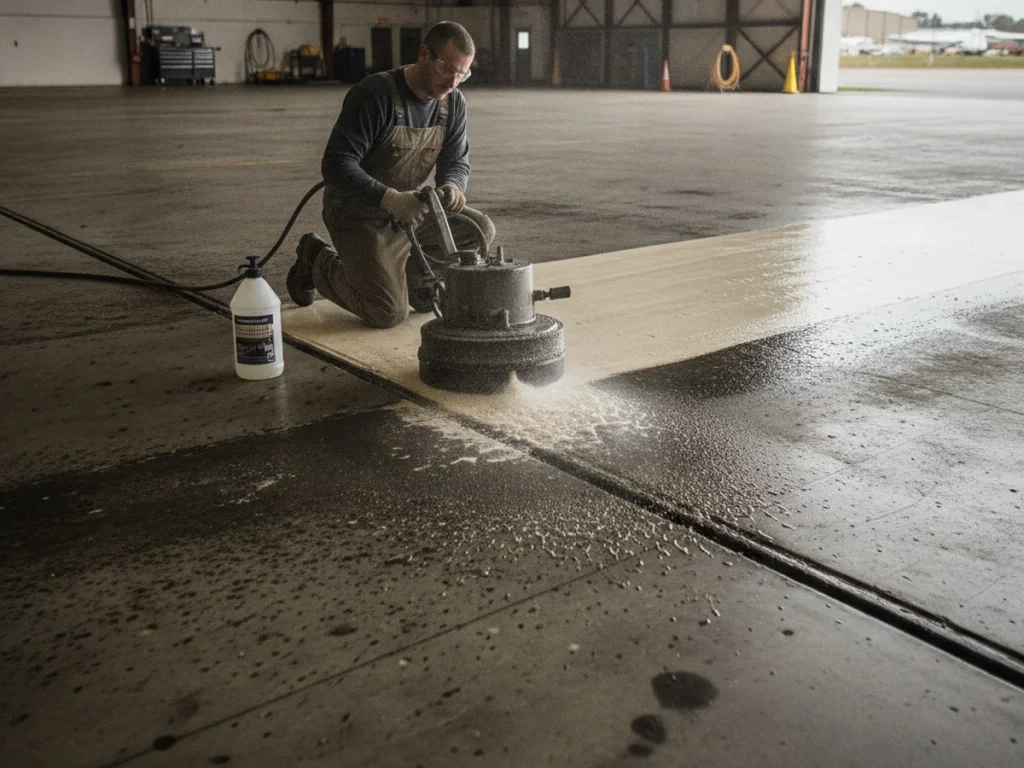
Hit an epoxy floor with high pressure and a turbo nozzle and you risk chipping the surface, lifting seams and edges, and driving water under the coating where it does no good. The instinct to blast a stain harder is the instinct that damages the floor you are trying to protect. Oil and fuel do not respond to pressure anyway. They respond to the right degreaser, dwell time, and pH-neutral chemistry that lifts the contaminant without attacking the coating.
The right approach looks more like controlled concrete and coated-floor cleaning than a pressure blast: pre-treat the grease and fuel spots, use a surface cleaner that contains the water and reclaims it rather than sheeting it across the bay, keep pressure in a safe range, and finish so floor markings and safety lines stay visible. Those painted lines are not decoration. They keep aircraft positioned and crews safe, and aggressive cleaning that fades them creates its own hazard.
This is the specific knowledge that separates a crew that cleans hangars from a crew that happens to own a pressure washer.
The Long Island factor: salt, humidity, and coastal air
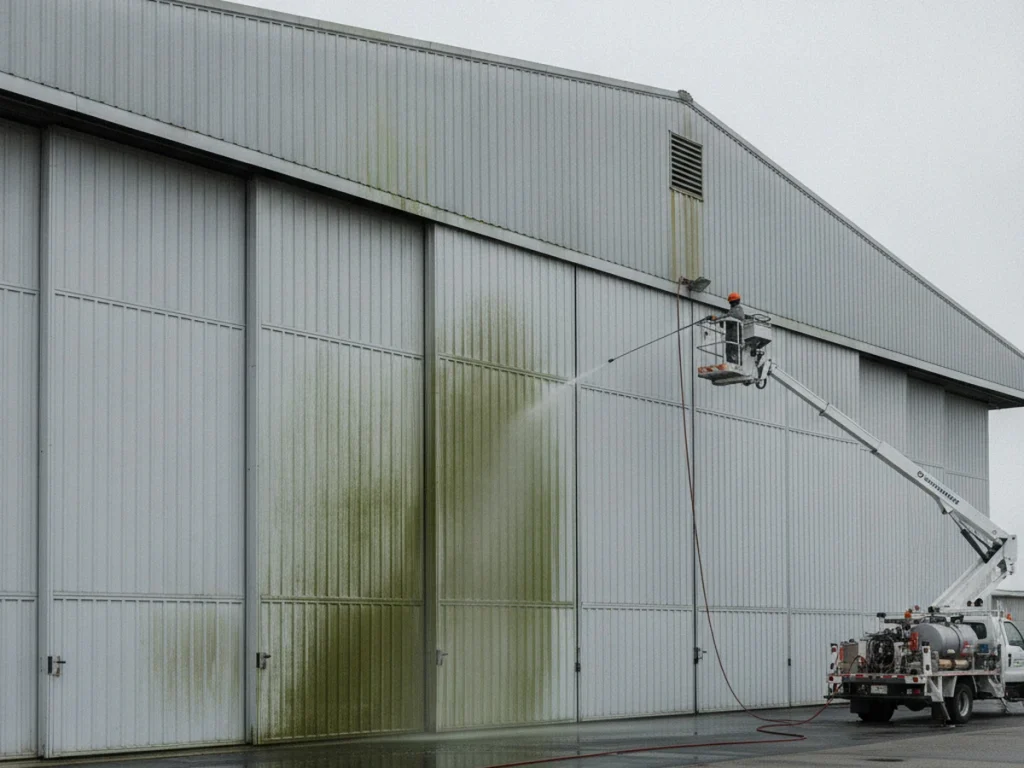
Long Island puts a particular load on aviation facilities. Winter road salt comes in from every vehicle and every boot. Coastal salt air is present year round and pushes corrosion on both aircraft and structure. Summer brings humidity that feeds mold and algae on exterior walls, and the north-facing side of a metal hangar building holds that green film long after the rest has dried. Fall drops pollen and organic debris that stains and clogs.
None of that is dramatic on any single day. It is the cumulative wear that a coastal, four-season climate grinds into a building over years. Removing salt and grime on a schedule is how you keep it from becoming permanent, and it is the same reasoning behind preventing salt damage on Long Island exteriors generally. A hangar is a bigger, more expensive version of the same problem.
Scheduling around aircraft that cannot move, or cannot wait
The real constraint in hangar cleaning is not the cleaning. It is the operation happening around it.
Aircraft may be parked and immovable, or the bay may need to stay available for arrivals and departures on short notice. Fuel systems, avionics, and tooling all need protection from water and overspray. A crew that shows up expecting an empty warehouse is a crew that gets in the way. The work has to be planned around flight schedules, staged so aircraft and equipment are masked and protected, and often done overnight or in windows when the bay is clear.
That is where access and responsiveness matter more than they do on a strip mall. A vendor available on a fixed daytime block does not fit a facility that runs on aviation time. Doing the work with minimal disruption, on the facility’s schedule rather than the cleaner’s, is the whole job.
The exterior counts too
It is easy to focus on the floor and forget the building. The facade, the large doors, the roof, and the surrounding pavement all form the first impression before anyone steps inside. Streaking and algae on a hangar exterior signal neglect to a prospective tenant deciding where to base an aircraft, and to a charter client forming a view of the operation in the first ten seconds. Clean approaches and clean walls do quiet work for a facility that competes for based aircraft and lease revenue.
Roof and gutter buildup matters for the same practical reason it does on any commercial roof: water that cannot drain finds its way inside, and the inside of a hangar is full of things you do not want water near.
FAQ
How often should a commercial hangar floor be cleaned? It depends on traffic and use, but most active hangars benefit from a routine deep clean on a set interval, with spot treatment of fuel and oil as it happens. High-traffic bays and shared public fields need it more often than a single-aircraft private hangar. The point is a schedule, not waiting for the floor to look bad.
Can you pressure wash a hangar floor without damaging the coating? Yes, with the right method. Coated and polished floors call for controlled pressure, pH-neutral chemistry, and proper degreasing rather than high-pressure blasting. Done correctly, the coating and the safety markings stay intact and the contaminants still come up.
Do you clean around aircraft and active operations? That is the norm in aviation. The work is planned around flight schedules and staged so aircraft, avionics, and equipment are protected, often in overnight or off-peak windows so operations keep running.
Does salt from Long Island winters really affect a hangar interior? It does. Road salt rides in on tires and boots and holds moisture against concrete and metal, and coastal salt air adds to it year round. Left in place, it feeds corrosion on both the structure and the aircraft, which is why removing it on a schedule matters here more than inland.
What is the difference between hangar floor cleaning and full aviation facility cleaning? Floor cleaning addresses the deck, degreasing, and FOD control. Full facility care extends to the exterior facade, doors, roof, gutters, and surrounding pavement, all of which affect appearance, drainage, and long-term wear.
The takeaway
A hangar is one of the most expensive assets a commercial aviation operator manages, and the things that quietly degrade it, salt, oil, fuel film, dust, and coastal moisture, are the cheapest to stay ahead of and the most expensive to ignore. A clean, well-kept hangar protects the aircraft inside it, lowers the liability the floor creates, and tells every client and tenant that the operation is run by people who pay attention.
The operators who avoid the expensive surprises are the ones who put the work on a scheduled commercial maintenance plan instead of reacting to it. If your Long Island hangar has not been properly cleaned since before last winter, the salt and buildup you are carrying now are the cheapest they will ever be to remove.